


Dissolved gas analysis (DGA) reveals evidence of thermal and electrical stress inside an oil-immersed transformer by measuring gases generated as oil and solid insulation deteriorate. It can help distinguish overheating, partial discharge, and higher-energy discharge activity, but it does not locate a fault precisely or establish its severity from one gas reading alone.
A routine oil report may show rising hydrogen or acetylene while external temperatures remain normal and no protection device has operated. The practical question is whether this represents an active internal fault, residual gas from an earlier event, or a sampling problem. That distinction determines whether maintenance should verify the sample, shorten monitoring intervals, investigate operating conditions, or escalate for an outage assessment.
Reading the gas pattern, not just the highest number
Laboratories usually report dissolved gas concentrations in parts per million by volume. The diagnostic value comes from the combination of gases, their development over time, and the transformer’s operating history. Typical associations are useful starting points, not exclusive fault signatures.
Acetylene deserves prompt attention, but its presence does not automatically prove an active main-tank arc. A stable residual concentration after a documented event has a different meaning from newly appearing acetylene that continues to rise. Conversely, low gas concentrations cannot guarantee freedom from a developing fault, particularly soon after fault inception.
Why the trend can change the maintenance decision
A concentration records accumulated gas, not necessarily current fault activity. A transformer with elevated but stable gases may require a different response from one with lower concentrations that are increasing rapidly. Compare successive reports using actual sampling dates rather than assuming equal intervals.
A simple concentration rate is the change in ppm divided by elapsed days. It is useful only when samples are comparable. Oil replacement, topping up, filtration, degassing, leaks, and changes in laboratory method can interrupt the trend. Concentration rates also cannot be compared blindly between transformers with different oil volumes or preservation systems.
Record load, ambient temperature, oil temperature, cooling status, and recent switching events alongside each sample. Rising ethylene during heavy loading warrants investigation of cooling performance, but should not be dismissed as normal solely because the load increased. Gas growth that continues under reduced loading may suggest a persistent localized problem rather than temporary bulk heating.
Confirm sample integrity before diagnosing the transformer
Unexpected results justify checking how the sample was obtained. Air bubbles, contaminated containers, insufficient flushing, and incorrect sample identification can distort interpretation. Repeatedly sampling from different points can also introduce differences unrelated to fault development.
- Identify the oil compartment. Main-tank oil and separately contained on-load tap-changer oil must not be treated as interchangeable. Normal tap-changer switching can generate gases that would be concerning in the main tank.
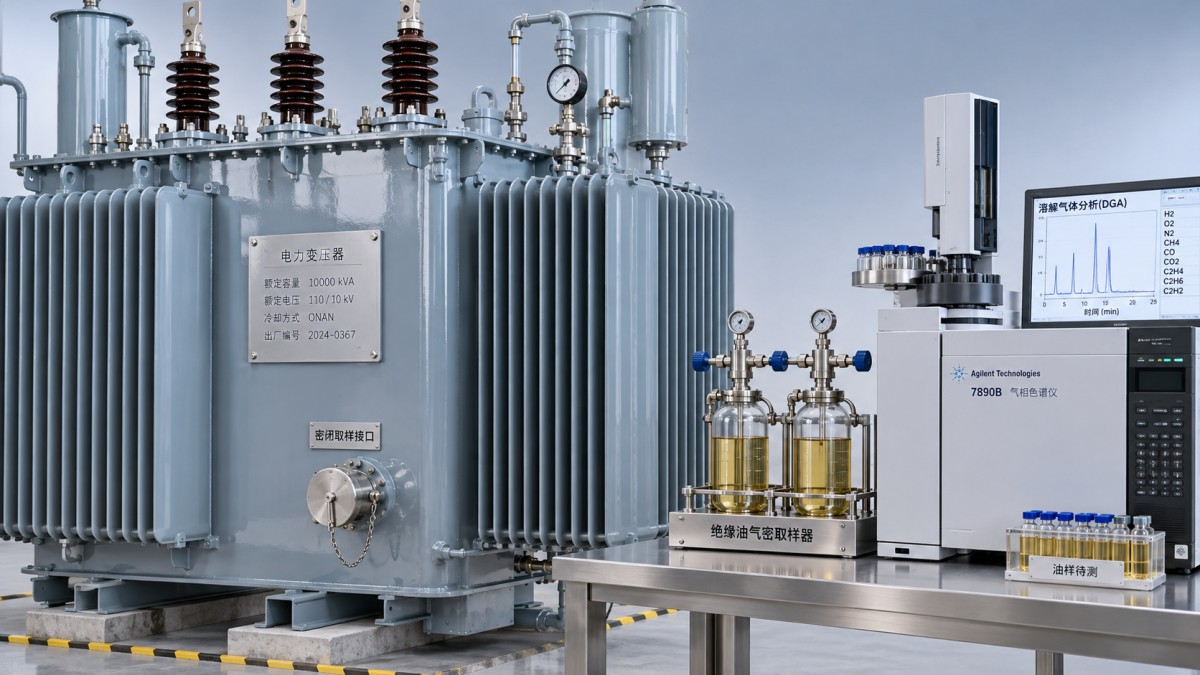
- Use the specified sampling procedure. Follow the manufacturer’s instructions and the applicable laboratory procedure, using suitable gas-tight equipment and preventing air entry.
- Document intervening work. Include oil treatment, repairs, topping up, abnormal loading, and protection operations on the sample record.
- Verify an unexpected result. Arrange a repeat sample or laboratory review promptly when appropriate, without delaying protective action if other evidence indicates an urgent fault.
Sampling from energized equipment requires authorized personnel and site-specific controls for electrical exposure, hot oil, and pressure. Do not open fittings or operate valves merely to obtain a confirmation sample without checking the approved procedure.
Use diagnostic standards within their boundaries
IEC 60567 addresses sampling and analysis of free and dissolved gases. IEC 60599 provides interpretation guidance for mineral-oil-filled equipment, while IEEE C57.104 addresses interpretation of gases generated in mineral-oil-immersed transformers. Use the applicable edition together with utility procedures and manufacturer guidance; product construction or efficiency standards are not substitutes for DGA interpretation guidance.
Gas-ratio methods and graphical methods such as the Duval Triangle can classify patterns consistent with thermal or electrical faults. They should follow a review of concentration significance and analytical reliability. Ratios become unstable when a denominator is near the detection limit, and mixed faults may produce ambiguous classifications. A graphical fault category is not an independent instruction to trip or continue operating.
Total dissolved combustible gas can support screening and trending, but it compresses several gases into one number. A similar total can represent substantially different risks depending on whether the increase comes mainly from carbon monoxide, hydrogen, or acetylene. Report individual gases alongside the total.
Match follow-up tests to the suspected mechanism
Once the result is credible, select checks that test the emerging diagnosis rather than ordering every available test.
- Thermal pattern: review loading, phase imbalance, cooling equipment, radiator condition, and temperature records. External thermography can reveal accessible connection or cooling problems, but cannot exclude internal hot spots.
- Discharge pattern: assess protection records, bushings, connections, and relevant electrical tests. Specialist partial-discharge investigation may be appropriate when the evidence supports it.
- Possible cellulose involvement: consider furan analysis, moisture assessment, and insulation condition tests. Oil treatment and paper type affect furan interpretation, so neither carbon oxides nor furans alone establish remaining insulation life.
Oil dielectric strength, moisture, and acidity measurements add information about oil and insulation conditions. A satisfactory breakdown-voltage result does not cancel an abnormal DGA trend: the tests measure different aspects of condition.
Sealed construction still needs a diagnostic baseline
Preservation design affects gas behavior and maintenance access. The S11 Series Oil-Immersed Power Transformer uses a fully sealed structure without an oil conservator, with corrugated sheets accommodating oil-volume changes. Isolation from ambient air helps limit oil deterioration, but does not eliminate internal thermal or electrical faults.
For such equipment, retain available factory or commissioning results as reference data and follow the specified sampling provisions. Avoid unnecessary opening of the sealed system. A design that reduces routine maintenance does not make an abnormal gas trend irrelevant.
Escalation should combine gas pattern, growth rate, and corroborating evidence. Rapidly increasing discharge gases accompanied by a protection operation or other abnormal behavior require immediate operational review under site procedures. A modest isolated increase without supporting symptoms may instead justify prompt verification and closer monitoring. Document the evidence, responsible decision-maker, and next sampling or testing interval so that the response is traceable rather than based on a single unexplained laboratory number.



 How to verify the temperature-rise test of an SCB12 dry-type transformer
 Distribution transformer maintenance tips for spotting oil leaks
 What dissolved gas analysis reveals about an oil-immersed transformer
 Why an oil-cooled transformer overheats despite a normal oil level
 How the amorphous core affects SCBH15 dry-type transformer losses
 Sizing S13 oil-immersed transformers for variable wind farm output
GET A FREE QUOTE
We offer reliable products, competitive prices, and nationwide professional support, committed to providing customers with efficient and energy-saving power equipment solutions.