


An “SCB13 Type Dry-Type Transformer eco-friendly” claim should be backed by measurable evidence, not marketing language alone. For quality control and safety managers, assessing that claim means checking verified loss data, insulation materials, fire-performance documentation, and end-of-life handling options. The decision is not simply whether a transformer contains oil. It is whether the proposed unit delivers credible environmental benefits without compromising electrical safety, reliability, or site requirements.
A brochure may describe a transformer as green, low-loss, and maintenance-friendly. Before those descriptions enter your procurement specification, turn each one into a question the supplier can answer with a document, test result, or clearly defined comparison.
Start by defining what “eco-friendly” means for your site
SCB13 generally identifies a cast-resin dry-type transformer series in Chinese model nomenclature. The designation alone does not establish a carbon footprint, fire-performance class, or recycling rate. Even transformers carrying the same series designation may differ in capacity, winding materials, enclosure, cooling arrangement, and guaranteed losses.
Your environmental priorities should reflect the installation. In an indoor electrical room, eliminating insulating-oil leakage may be valuable. At a lightly loaded facility that remains energized continuously, no-load losses may dominate the energy comparison. Near occupied spaces, noise and ventilation requirements also deserve attention.
Check the loss data before accepting an efficiency claim
Ask for no-load loss and load loss separately, rather than accepting a single efficiency percentage. No-load loss occurs whenever the transformer is energized. Load loss varies approximately with the square of load current under comparable conditions. A unit with attractive full-load efficiency may therefore be less favorable for a building that operates at low utilization for much of the year.
A useful screening calculation is:
Annual transformer loss energy ≈ Σ[(P0 + Pk × x2) × operating hours]
Here, P0 is no-load loss in kilowatts, Pk is rated load loss at the stated reference temperature, and x is the load fraction for each operating interval. Use energized hours for no-load losses. Evaluate varying loads in separate intervals rather than squaring the annual average load.
This is an engineering estimate, not a substitute for a detailed operating model. Temperature, harmonics, auxiliary fans, and room cooling can change the result. Where variable-speed drives or other nonlinear loads are significant, request an assessment of additional losses and thermal suitability.
For a fair comparison, align rated capacity, voltage ratio, frequency, impedance, winding arrangement, cooling mode, and reference temperature. Confirm whether each figure is a guaranteed value, a typical catalog value, or a measured result. Procurement documents should also define permitted tolerances and acceptance criteria.
If the supplier translates energy savings into avoided carbon emissions, request the calculation period and electricity emission factor. Lower operating losses support an operational emissions claim; they do not, by themselves, prove a lower whole-life environmental footprint.
Read fire and material claims as separate questions
A dry-type transformer removes the need for an insulating-oil inventory, but “oil-free” does not mean noncombustible, smoke-free, or environmentally harmless. Cast-resin insulation still requires attention to thermal behavior, fire exposure, and waste handling.
For quality and safety review, request:
- Insulation details: resin system, thermal class, and relevant material safety information.
- Fire-performance evidence: declared classification under the applicable standard, such as IEC 60076-11 where specified, with supporting test documentation.
- Environmental and climatic suitability: evidence appropriate to humidity, condensation, contamination, altitude, and temperature at the installation.
- Restricted-substance declarations: documents tied to the supplied materials and applicable market requirements, rather than a generic “non-toxic” statement.
Check whether reports cover the offered model or a representative design, and ask the supplier to explain any claimed coverage. A fire-behavior classification is not a guarantee of zero smoke or zero risk. Building fire strategy, protection coordination, clearances, and emergency procedures remain necessary.
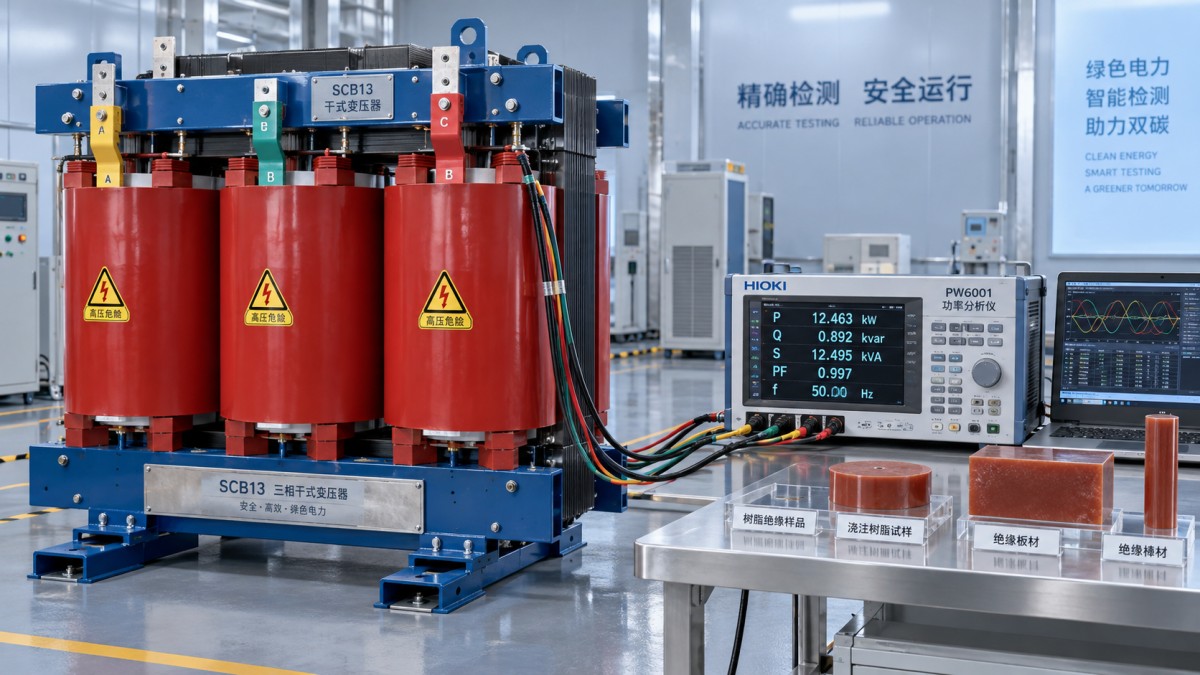
A practical review follows one chain: identify the claim, locate the supporting report, confirm its scope, and connect the result to a site requirement. Missing links should become clarification items before purchase approval.
Do not confuse quality certification with environmental proof
ISO 9001 certification concerns a quality management system. It can support confidence in controlled manufacturing and inspection processes, but it does not certify that a particular SCB13 transformer is environmentally superior.
Jiangsu Shengda Power Equipment Co., Ltd. describes its business as transformer research, development, production, and sales, with comprehensive quality inspection systems and ISO 9001 certification. Its range includes SCB-series dry-type transformers, low-loss oil-immersed transformers, amorphous alloy transformers, and compact substations. For procurement, these capabilities should lead to a model-specific technical submission—not replace one.
The company’s supplied background references GB1094.1-2-1996 and GB/T6451-2008. These are Chinese standards references, not proof of compliance with every international requirement. Confirm the exact standards, editions, and product scope applicable to the proposed dry-type unit, including any current requirements imposed by your jurisdiction or contract.
Where independently verified environmental declarations or life-cycle assessments are available, examine their boundaries and assumptions. Compare equivalent ratings, service life, load profiles, electricity mixes, and end-of-life scenarios. Otherwise, an apparently precise carbon figure may conceal an unsuitable comparison.
Keep an oil-immersed alternative in the comparison when appropriate
A credible selection review does not assume that dry-type construction is always the lowest-impact choice. Indoor fire strategy, spill containment, maintenance access, and operating losses can point toward different solutions.
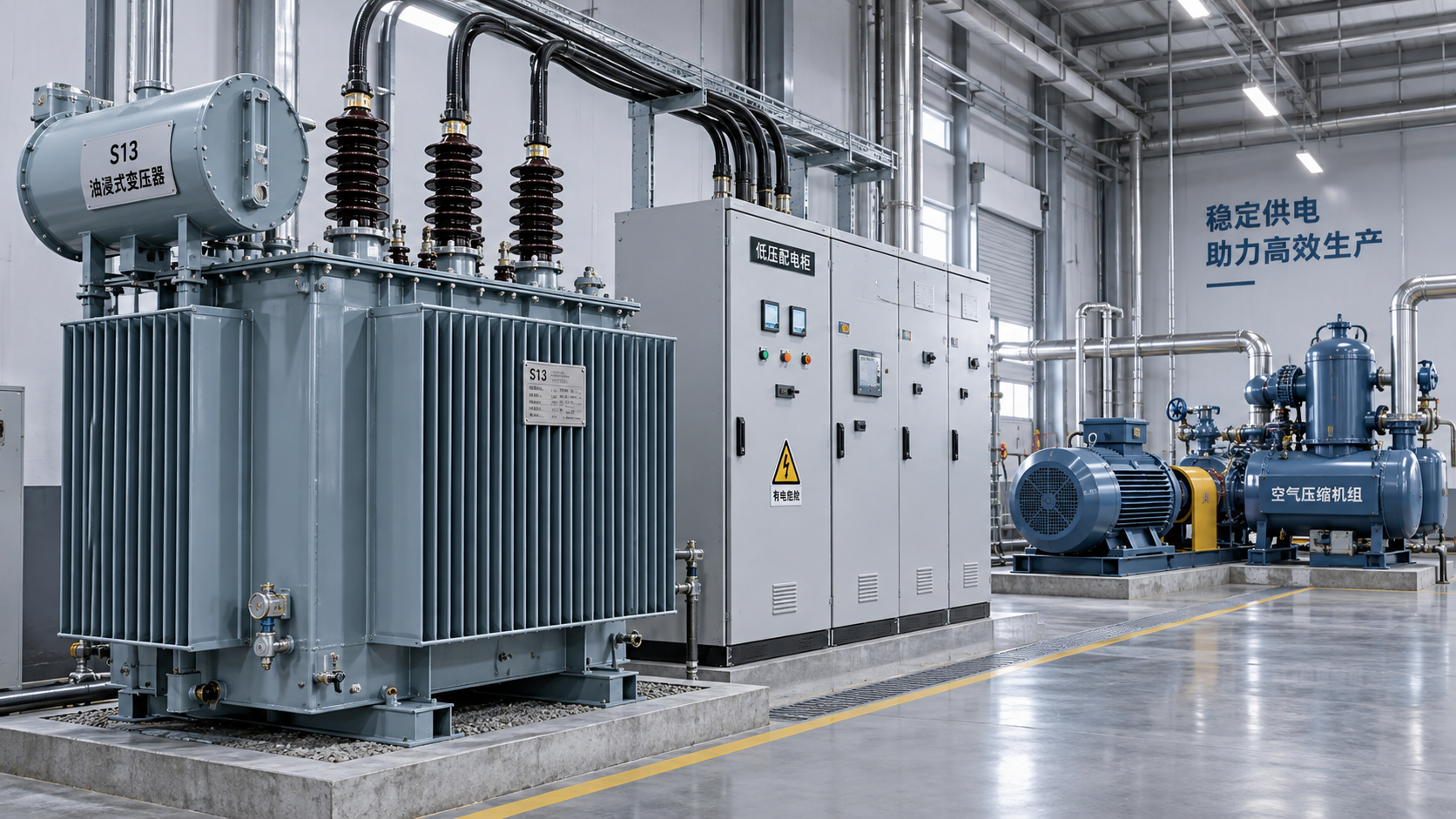
For sites where an oil-immersed design is acceptable, Shengda’s S20 Series Oil-Immersed Power Transformers offers a relevant alternative to evaluate. The supplied range covers 30–2,500 kVA, with listed no-load losses from 70 to 1,440 W across those ratings. Its specifications reference GB20052-2020 and JB/T10088-2016. These are oil-immersed product data and must not be presented as SCB13 performance figures.
The supplier also states an average noise reduction of 20% against the referenced national-standard benchmark. Before using that claim, request the tested quantity, units, measurement conditions, and model coverage. A percentage reduction cannot automatically be interpreted as the same percentage reduction in decibels.
Make environmental benefits part of the acceptance criteria
End-of-life planning often receives less attention than efficiency, yet it exposes weak claims quickly. Copper or aluminum windings and steel cores have recovery value, but separating resin-bonded components may require specialist processing. Ask who can perform that work locally and which residual materials require controlled disposal.
Before approval, assemble a compact evidence file containing the offered model’s guaranteed losses, applicable test reports, material declarations, installation requirements, and recovery guidance. Include fan consumption, ventilation needs, acoustic limits, and temperature monitoring where relevant to the project.
Accept a specific benefit, not an unrestricted label. “Lower estimated annual loss energy under our load profile” or “no insulating-oil spill exposure at this location” is more defensible than “environmentally friendly.” If evidence is incomplete, make approval conditional on clarification or testing. That approach protects both the environmental objective and the people responsible for safe, dependable operation.



 How to assess environmental claims for SCB13 dry-type transformers
 Sizing an S13 oil-immersed transformer for industrial motor starting
 What enclosure protection does an SCB13 transformer need against dust?
 How to verify the temperature-rise test of an SCB12 dry-type transformer
 Distribution transformer maintenance tips for spotting oil leaks
 What dissolved gas analysis reveals about an oil-immersed transformer
GET A FREE QUOTE
We offer reliable products, competitive prices, and nationwide professional support, committed to providing customers with efficient and energy-saving power equipment solutions.