


Step-by-Step Dry-Type Transformer Installation and Commissioning Guide
Proper dry-type transformer installation and commissioning are essential for safe operation, long service life, and stable power distribution.
This step-by-step guide covers site inspection, handling, installation, electrical testing, protection checks, and final energization.
For industrial facilities, commercial buildings, and compact substations, each step should follow applicable standards and project specifications.
Why a Checklist Matters for Dry-Type Transformer Installation
A dry-type transformer is often installed near loads, switchgear, ventilation systems, and building structures.
Small installation errors may cause overheating, abnormal noise, insulation damage, or nuisance tripping during operation.
A clear commissioning checklist reduces omissions and helps verify mechanical, electrical, and environmental conditions before energization.
Jiangsu Shengda Power Equipment Co., Ltd. applies strict quality control and international standards across transformer design and production.
Pre-Installation Inspection Checklist
- Verify the transformer nameplate, rated capacity, voltage ratio, frequency, insulation class, impedance, and connection group against design documents.
- Inspect the enclosure, coils, core clamps, terminals, fans, temperature controller, and accessories for transport damage or loose parts.
- Check the installation foundation for levelness, load-bearing capacity, embedded steel, anti-vibration pads, and required maintenance clearance.
- Confirm indoor conditions, including ventilation, dust level, humidity, corrosive gas exposure, and access for future inspection.
- Review drawings for cable entry direction, busbar arrangement, grounding route, protection interface, and fire safety requirements.
Do not install a dry-type transformer in a damp, contaminated, or poorly ventilated space without corrective measures.
Handling, Positioning, and Mechanical Installation
Move the transformer with approved lifting points, suitable slings, and balanced force distribution.
Avoid impacts on coils, resin surfaces, temperature sensors, cooling fans, and terminal assemblies.
- Lift slowly and keep the transformer upright to prevent frame distortion or insulation stress during movement.
- Position the unit according to the drawing, maintaining safe electrical clearance and service access around all sides.
- Secure the base after alignment, then check that vibration pads and anchor bolts are correctly installed.
- Remove transport fixtures, temporary covers, packaging materials, and foreign objects before cable termination.
If the transformer has forced-air cooling, keep air inlets and outlets unobstructed.
Ventilation design should support rated load operation and expected ambient temperature.
Grounding, Cable Connection, and Electrical Assembly
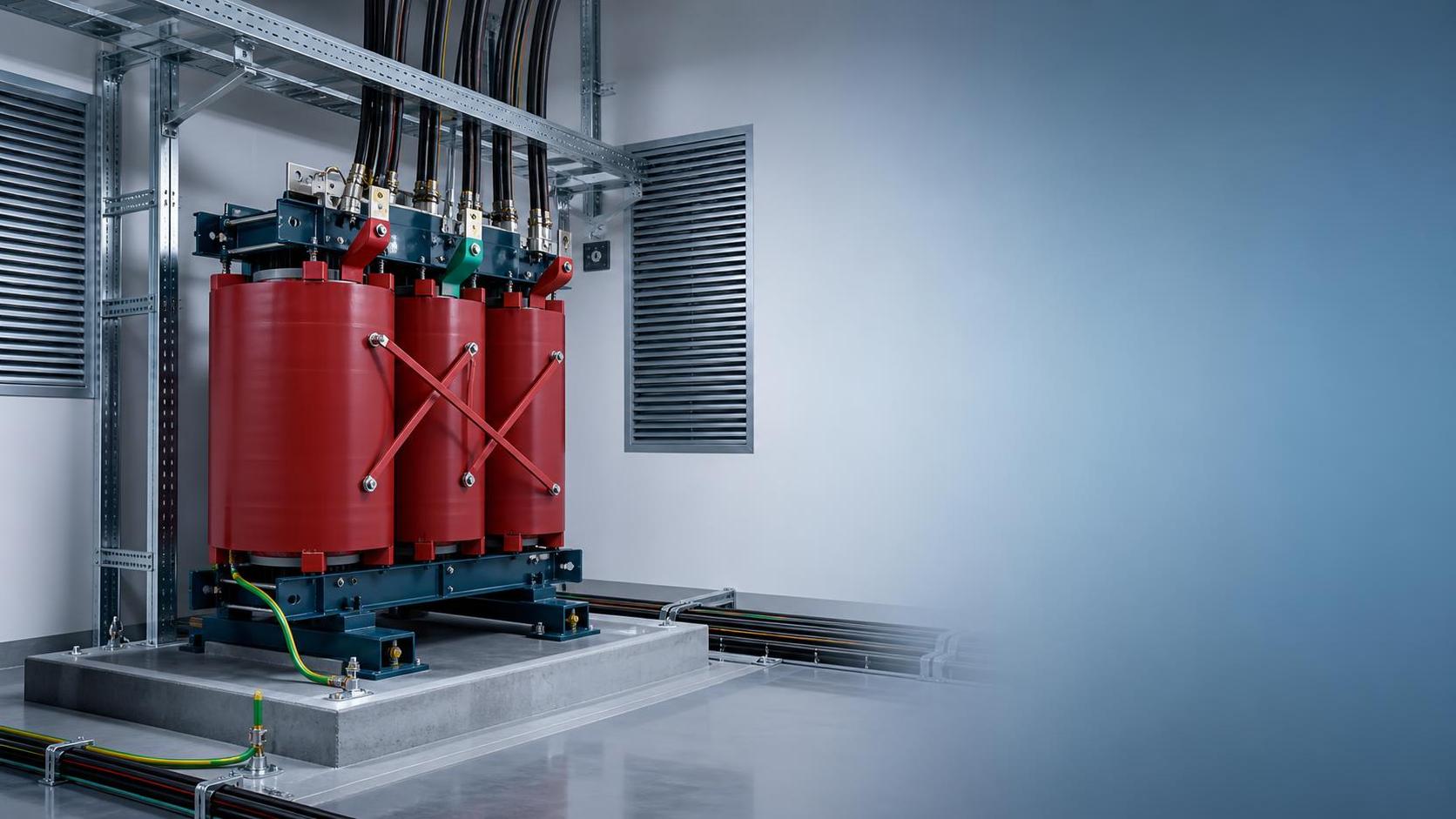
Grounding is a critical step in dry-type transformer installation and commissioning.
Connect the transformer frame, enclosure, neutral point where required, and cable armor to the grounding system.
- Clean contact surfaces before cable connection, then apply proper torque to terminals and busbar joints.
- Maintain phase sequence consistency between medium-voltage switchgear, transformer terminals, and low-voltage distribution boards.
- Use flexible connectors where vibration, thermal expansion, or alignment deviation may affect rigid busbar connections.
- Protect cables from sharp edges, excessive bending, moisture ingress, and mechanical strain near termination points.
After connection, inspect creepage distance, insulation sleeves, cable lugs, and phase-to-phase clearance.
Commissioning Test Checklist Before Energization
Commissioning confirms that the dry-type transformer is ready for safe and stable energization.
Test records should be complete, signed, and compared with factory data where available.
- Measure insulation resistance between high-voltage winding, low-voltage winding, and ground using a suitable megohmmeter.
- Perform winding resistance measurement to identify loose joints, poor contact, or abnormal phase imbalance.
- Check voltage ratio and vector group to confirm correct tap position and phase displacement.
- Verify temperature controller settings, sensor wiring, alarm outputs, trip contacts, and fan start-stop functions.
- Inspect protection coordination, relay settings, breaker operation, interlocks, and emergency shutdown functions.
If test results are abnormal, stop commissioning and identify the cause before energization.
Final Energization Procedure
Before first energization, confirm that tools, debris, covers, and temporary grounding devices have been removed.
The area should be restricted, dry, clean, and supervised according to the site safety plan.
- Energize the transformer without load first, then observe sound, vibration, smell, and temperature controller indication.
- Measure no-load voltage on the low-voltage side and confirm that phase sequence matches the distribution system.
- Apply load gradually, monitoring current balance, winding temperature, fan operation, and protective device status.
- Record operating voltage, current, ambient temperature, load percentage, noise condition, and any alarm event.
A stable no-load period helps detect abnormal excitation noise, wiring errors, or incorrect tap settings early.
Application Notes for Different Installation Scenarios
Industrial Facilities
Industrial loads may include motors, drives, welding equipment, and nonlinear devices.
Check harmonic levels, short-time overload conditions, ventilation capacity, and fault protection coordination.
Commercial Buildings
Commercial transformer rooms often require low noise, compact layout, and easy maintenance access.
Confirm that enclosure protection, fire separation, cable routing, and acoustic performance meet building requirements.
Compact Substations
Compact substations require careful coordination between transformer, switchgear, low-voltage cabinet, and ventilation channels.
When projects also need low-loss oil-immersed solutions, S20 Series Oil-Immersed Power Transformers can support energy-saving distribution applications.
This series covers 30 to 2500 KVA, supports Yyn0 or Dyn11 connection, and complies with GB20052-2020 and JB/T10088-2016.
Commonly Missed Risks During Commissioning
Ignoring dust contamination. Dust on resin surfaces may reduce insulation performance, especially in humid environments.
Overlooking ventilation paths. Blocked air channels can cause temperature rise even when load current appears normal.
Using incorrect torque. Loose terminals may create heat, while excessive torque may damage conductors or terminal hardware.
Skipping protection verification. Alarm, trip, and fan circuits must be tested before load operation.
Failing to compare test data. Phase imbalance, low insulation resistance, or abnormal ratio results require immediate investigation.
Practical Execution Tips
- Prepare the dry-type transformer installation checklist before delivery, not after the equipment arrives on site.
- Keep factory test reports, drawings, manuals, and commissioning forms in one project file.
- Assign one person to control test records and another to verify safety isolation.
- Repeat visual inspection after cable termination because tools and debris are often left behind.
- Schedule a follow-up thermal inspection after initial operation under representative load conditions.
A reliable commissioning process depends on discipline, not speed.
Clear records also simplify maintenance, troubleshooting, warranty review, and future capacity planning.
Summary and Next Steps
Dry-type transformer installation and commissioning should follow a structured sequence from inspection to energization.
Focus on site conditions, mechanical positioning, grounding, electrical testing, protection checks, and controlled load application.
Jiangsu Shengda Power Equipment Co., Ltd. offers transformer expertise backed by advanced manufacturing and strict quality inspection systems.
For upcoming power distribution projects, review specifications early and align transformer selection with safety, efficiency, and operating conditions.


 How to Compare ZGS Combined Substation Suppliers on Lead Time and Support
 How Low Noise Improves Indoor Use of SCB13 Dry-Type Transformers
 Where an Explosion Proof Transformer Is Required by Safety Conditions
 Distribution Transformer Installation Guide: Common Site Errors to Avoid
 What Affects SCB14 Type Dry-Type Transformer Price Besides Rated Capacity
 SCB12 Type Dry-Type Transformer Applications That Benefit from Resin Insulation
GET A FREE QUOTE
We offer reliable products, competitive prices, and nationwide professional support, committed to providing customers with efficient and energy-saving power equipment solutions.