


An F1 fire behaviour rating means a dry-type transformer meets the applicable IEC 60076-11 requirements for restricted flammability under specified test conditions. It does not mean the transformer is fireproof. When reviewing a flame retardant transformer for an indoor electrical room, the practical question is whether the rating is supported by a relevant test report—not whether the brochure contains the word “F1.”
This distinction matters when approving equipment near occupied areas, evacuation routes, or other critical services. An unsupported rating can leave a gap in the fire-risk assessment; a genuine rating can also be misused if it is treated as permission to remove ventilation, detection, separation, or electrical protection measures.
F1 describes fire behaviour, not fire resistance
IEC 60076-11 covers dry-type power transformers and includes fire behaviour classifications. F1 applies to transformers required to have restricted flammability. The classification also addresses minimising the emission of toxic substances and opaque smoke. These objectives concern the transformer’s behaviour when exposed to the prescribed fire conditions.
F1 is not a fire-resistance duration. It does not establish how long a transformer will remain operational in a building fire, nor does it give the equipment a fire-rated enclosure. A transformer carrying this classification should not be described as able to withstand fire indefinitely or continue supplying power during a fire.
The distinction between F0 and F1 is useful during specification review. F0 does not impose the special fire behaviour requirements associated with F1. However, an F0 designation alone is not a complete assessment of installation safety: the building arrangement, equipment construction, and protective systems still matter.
Read the test report before accepting the label
A common document-review problem is receiving an F1 statement alongside routine electrical test results. Those results may establish winding resistance, losses, insulation performance, or other production checks, but they do not replace fire behaviour testing. The evidence must address the claimed classification directly.
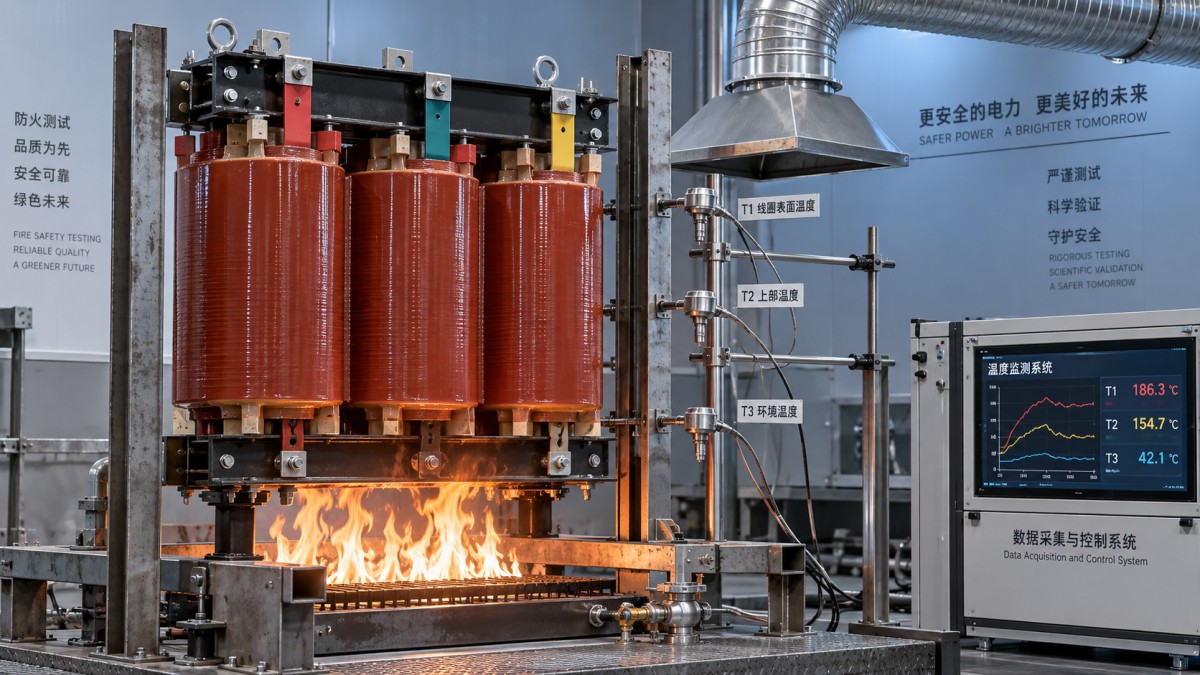
The prescribed fire test uses a representative transformer test object exposed to defined ignition and heating conditions. Its purpose is to assess behaviour under controlled conditions, including the development and decay of combustion and smoke-related performance. It is not a recreation of every possible electrical-room fire.
Ask for the applicable standard edition and the complete report, including specimen identification, test arrangement, measured results, acceptance criteria, and conclusion. A certificate or summary can help identify the claim, but it may not contain enough information to establish that the offered design is covered.
Do not interpret a smoke-related pass result as proof that every possible toxic gas has been individually measured. Check what the report actually records and how the applicable edition addresses harmful emissions. Where a project requires additional emission evidence, specify that separately rather than assuming the F1 designation supplies it.
Does the tested design match the transformer being supplied?
The most important traceability question is whether the report applies to the offered transformer. A fire behaviour report may concern a representative test specimen rather than every production unit. That makes the relationship between the tested construction and the supplied design essential.
Review the following points with the supplier:
- Identification: Do the report, technical offer, and drawings identify the same design family, with an explained relationship between the specimen and the supplied model?
- Insulation system: Are the resin, fillers, reinforcement, and other relevant combustible materials consistent with the tested construction?
- Construction: Have winding geometry, insulation quantities, or other fire-relevant features changed?
- Coverage: Where the offered rating differs from the tested specimen, what documented basis supports the claimed applicability?
- Report credibility: Is the issuing laboratory identifiable, and does its competence or accreditation satisfy the project’s requirements?
A shared model prefix or similar appearance is not sufficient evidence. Neither is a statement that the same resin is used. Material formulation, manufacturing controls, and the complete tested construction can affect fire behaviour.
When the relationship is unclear, request a written applicability explanation supported by technical records. Do not independently extrapolate a report across different capacities or constructions simply because they belong to the same catalogue series.
Keep material, transformer, and building approvals separate
A resin flammability certificate can support material selection, but it answers a narrower question than a transformer fire behaviour test. Likewise, ISO 9001 certification addresses a quality management system; it does not certify an individual transformer as F1.
Environmental and climatic classifications also serve different purposes. They concern specified environmental exposure and climatic service conditions, not the same performance as the fire behaviour class. Treat each designation as a separate requirement with its own supporting evidence.
For an indoor installation, the safety review must still consider cable routes, adjacent combustible materials, ventilation, access for emergency response, and the consequences of smoke entering occupied spaces. F1 does not resolve those building-level issues.
Electrical faults remain possible even where insulation has restricted flammability. Protection coordination, temperature monitoring, correct loading, and maintenance address ignition and overheating risks that the classification alone cannot prevent.
An oil-immersed option needs a different assessment
IEC 60076-11 F1 classification belongs to the dry-type transformer framework. It should not be transferred to oil-immersed equipment because that equipment is described as efficient, low-noise, or suitable for a particular site.
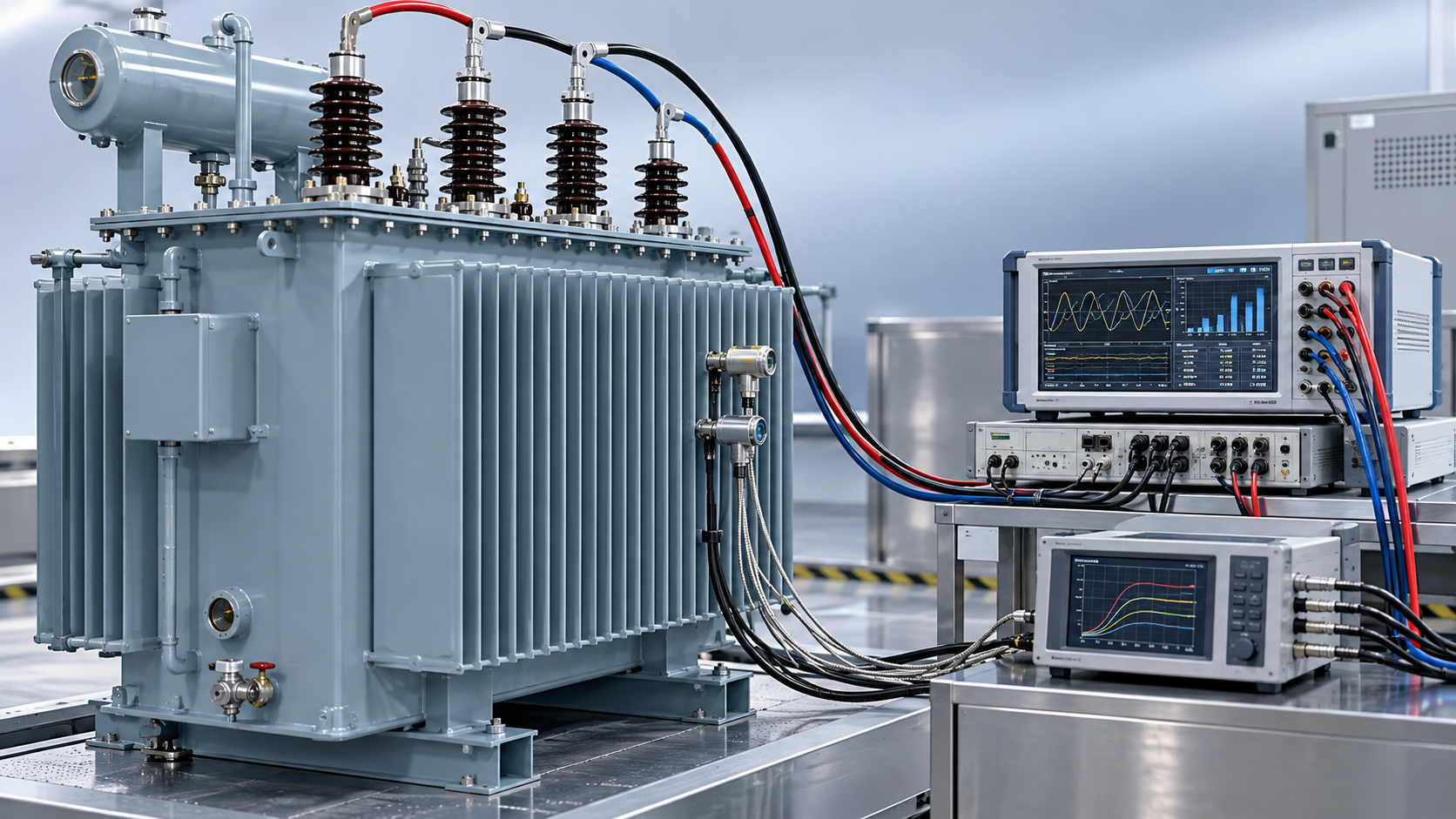
For example, the S22 Series Oil-Immersed Power Transformers is presented as an energy-saving range with optimised core and coil construction, reduced no-load loss, and noise-reduction features. Its supplied product information lists GB20052-2020 and JB/T10088-2016. These references and performance features do not establish an F1 classification.
If an oil-immersed design is being considered instead of a dry-type unit, evaluate its insulating liquid, containment arrangements, fire separation, and installation requirements on their own merits. Where the specification explicitly requires F1 under IEC 60076-11, changing technology requires a documented technical review rather than treating the two options as equivalent.
Turn the requirement into an approval decision
A procurement requirement should identify the transformer technology, required fire behaviour class, applicable IEC 60076-11 edition, and evidence needed before approval. Avoid wording such as “fireproof transformer,” which promises more than the classification demonstrates.
A practical requirement is: “Provide a dry-type transformer with F1 fire behaviour classification under the specified edition of IEC 60076-11, supported by the relevant test report and documented applicability to the offered design.” Add any project-specific requirements for laboratory competence, document acceptance, or design-change notification.
- Confirm that the offered equipment is within the applicable standard’s scope.
- Verify the report’s classification conclusion against its recorded results and acceptance criteria.
- Resolve differences between the tested specimen and the offered construction before release.
- Retain the accepted evidence with the equipment records and establish how relevant design changes will be reviewed.
Missing pages, unclear specimen identification, or unsupported design coverage should leave the F1 claim unverified until resolved. Even after the classification is accepted, approval of the installation remains a separate decision based on the electrical design, fire strategy, and applicable local requirements.



 What an F1 fire behaviour rating means for a flame-retardant transformer
 How enclosure specifications affect SCB18 dry-type transformer cost
 How to compare loss guarantees for S22 oil-immersed transformers
 When to choose a loop-feed pad-mounted transformer over radial feed
 How much spare capacity should a distribution transformer have?
 Checking S13 oil-immersed transformers for renewable inverter loads
GET A FREE QUOTE
We offer reliable products, competitive prices, and nationwide professional support, committed to providing customers with efficient and energy-saving power equipment solutions.