


Compare loss guarantees by asking three questions: are the figures measured on the same basis, are they binding acceptance limits, and what happens if the delivered transformer exceeds them? For S22 Series Oil-Immersed Power Transformers, a lower quoted loss only has purchasing value when all three answers are clear.
The S22 designation alone does not establish the loss guarantee for a particular unit. Your comparison needs separate guaranteed no-load and load losses, matching electrical ratings, defined test conditions, and an agreed treatment of tolerances. These details determine both operating cost and whether an apparently attractive quotation creates an enforceable commitment.
Put every quotation on the same technical basis
Start with the transformer specification before comparing watts. Rated capacity, voltage ratio, frequency, tapping arrangement, cooling method, and impedance requirements should match. Otherwise, the quoted losses may describe different designs serving different duties.
Impedance deserves attention because it affects fault current and voltage regulation. A design with attractive losses but unsuitable impedance may create additional system costs. Keep essential electrical requirements fixed while comparing efficiency.
Separate “typical,” “design,” and “guaranteed” values. A typical value can describe expected performance across a product range; it does not necessarily set a limit for your delivered unit. Use the contractual guaranteed figures when evaluating competing offers.
Keep no-load and load losses separate
No-load loss is the power consumed when the transformer is energized without supplying a load. It is mainly associated with the magnetic core and continues while the transformer remains energized. For a lightly loaded installation operating around the clock, reducing this loss can be particularly valuable.
Load loss arises when current flows through the transformer. It includes winding resistance losses and additional losses caused by leakage magnetic fields. At a consistent temperature basis, it varies approximately with the square of the load current. A heavily loaded installation therefore places greater economic weight on the load-loss guarantee.
A single “total loss” figure hides this distinction. One offer may have lower no-load loss but higher load loss than another. Either could deliver lower annual energy consumption, depending on the operating pattern. Request both figures even when a supplier also provides total loss or efficiency.
Load-loss temperature correction is another common source of misleading comparisons. Winding resistance changes with temperature, while additional loss components require their own treatment under the applicable test method. Do not compare a measured cold value with a value corrected to the contractual reference temperature, or apply a simple resistance correction to every loss component.
Tap position also needs to be explicit. A guarantee at the principal tap does not automatically describe every operating tap. If the installation will routinely use another position, address that duty in the specification.
Make the acceptance limit explicit
A quotation can state a guaranteed loss while also referring to standard tolerances. Depending on the agreed terms, the delivered unit could be accepted with measured losses above the headline figure. That affects the value of the guarantee.
Ask the supplier to state the maximum acceptable corrected result for each loss component and, where relevant, their sum. Specify whether any tolerance is permitted and whether it is already included in that maximum. Avoid wording that allows a tolerance to be added twice.
Individual and combined limits answer different questions. A total-loss limit may allow higher no-load loss to be offset by lower load loss. That trade-off could be unfavorable for a lightly loaded transformer. Separate limits prevent an unwanted shift between the two components.
The contract should name the applicable transformer standard, its edition, and any project-specific departures. GB and IEC references should be handled as specific technical requirements, rather than interchangeable statements of quality. A general compliance declaration or ISO9001 certificate does not replace a unit-specific loss guarantee.
Also define how measurement uncertainty will be handled when a result is close to the limit. The acceptance rule should be agreed before testing, including whether a disputed result triggers a repeat measurement or an independent test.
Convert guaranteed losses into operating cost
The lowest purchase price may carry the highest energy cost. Compare offers using the same operating hours, load profile, electricity price, evaluation period, and discount rate.
A useful screening calculation is:
Annual loss energy ≈ P0 × energized hours + Pk × Σ(load fraction² × hours in that load band)
Here, P0 is guaranteed no-load loss in kilowatts, and Pk is guaranteed rated-current load loss in kilowatts at the agreed reference temperature. Load fraction means operating current divided by rated current. The result is in kilowatt-hours.
Use several load bands when demand varies. Squaring the annual average load can understate load-loss energy because short periods of high demand contribute disproportionately. Metered current or apparent-power data generally provides a better basis than an estimate based only on average real power.
This calculation is an economic comparison model. Actual winding temperature, supply harmonics, voltage conditions, and auxiliary equipment consumption can change operating losses. Where these factors are material, use a more detailed model with the same assumptions for every offer.
Multiply annual loss energy by the relevant electricity cost, then discount future costs over the chosen evaluation period. A convenient tender method is to assign separate monetary values to each guaranteed watt of no-load and load loss:
Evaluated cost = purchase price + A × guaranteed no-load watts + B × guaranteed load-loss watts.
A and B should come from the installation’s expected duty. Publish them before bids are submitted so every supplier competes against the same economic criteria. For close comparisons, check whether reasonable changes in loading or electricity cost reverse the ranking.
Require evidence tied to the delivered transformer
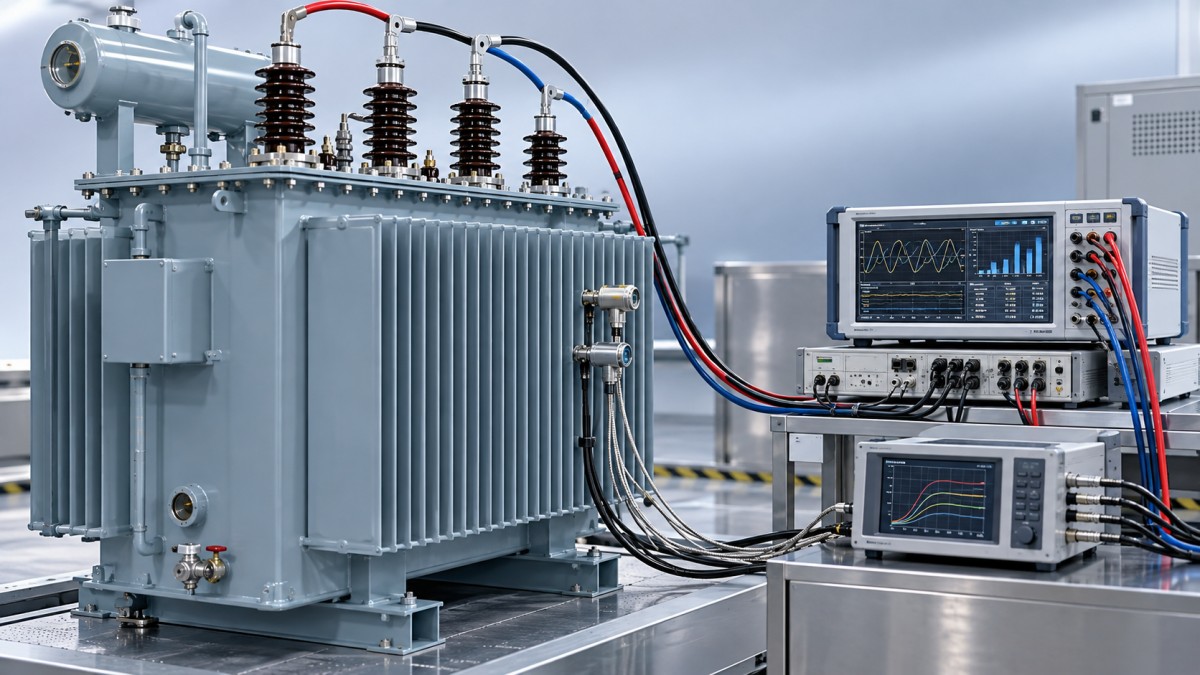
The factory test report should identify the transformer by serial number and show the test conditions, measured results, temperature corrections, and final values used for acceptance. A report for a similar model can support design assessment, but it does not demonstrate the losses of the unit being supplied.
For a critical installation or a large order, a witnessed factory acceptance test can make verification easier. Agree the witness arrangements, document access, and response to failed results before production. Witnessing only adds value when the acceptance criteria are already clear.
If an indoor installation leads you to consider a dry-type alternative, keep its comparison basis separate. The SCB11 Type Dry-Type Transformer can be configured with temperature control and air cooling. Its cooling duty, auxiliary consumption, and applicable load-loss reference conditions need their own evaluation; an oil-immersed transformer’s loss comparison cannot simply be transferred to it.
Agree the remedy before placing the order
A loss guarantee needs a defined response to failure. Specify whether an excessive result leads to correction and retesting, replacement, rejection, or an agreed financial adjustment. Set responsibility for additional testing, transport, and delay costs.
A financial adjustment can be reasonable for a limited deviation if it reflects the present value of the additional energy cost. It should require your acceptance and should not override mandatory efficiency requirements or other contractual performance limits.
Before signing, bring the guaranteed figures, maximum acceptance limits, test procedure, and remedies into one contractual schedule. The strongest offer is the one that combines suitable electrical performance with the lowest evaluated cost and a loss commitment you can verify on delivery.



 How to compare loss guarantees for S22 oil-immersed transformers
 When to choose a loop-feed pad-mounted transformer over radial feed
 How much spare capacity should a distribution transformer have?
 Checking S13 oil-immersed transformers for renewable inverter loads
 How to assess environmental claims for SCB13 dry-type transformers
 Sizing an S13 oil-immersed transformer for industrial motor starting
GET A FREE QUOTE
We offer reliable products, competitive prices, and nationwide professional support, committed to providing customers with efficient and energy-saving power equipment solutions.